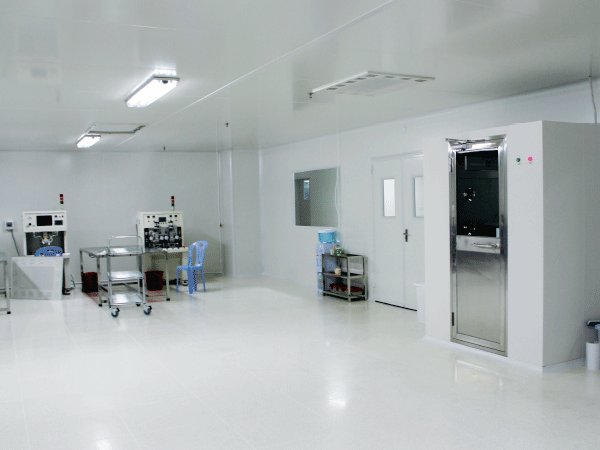
Contamination in precision manufacturing directly correlates with product defects, equipment downtime, and regulatory non-compliance. Purification engineering provides the systematic methodology to design, validate, and operate environments where airborne particles, molecular contaminants, and microbial loads are maintained below process-critical thresholds. This article examines the core principles of purification engineering—from filter efficiency modeling to pressure cascade verification—and offers actionable data for facility managers and process engineers. TAI JIE ER has applied these methodologies across more than 150 turnkey projects in semiconductor fabs, sterile filling lines, and lithium-battery dry rooms.
Purification engineering encompasses the design, implementation, and continuous improvement of contamination control systems. Unlike general HVAC, purification engineering integrates multiple physical and chemical removal mechanisms: mechanical filtration (HEPA/ULPA), electrostatic precipitation, adsorption (activated carbon for molecular contaminants), and laminar/unidirectional airflow management. Key performance indicators include:
Particle concentration (per ISO 14644-1 classes 1 through 9).
Air change rates (ACH) – ranging from 20 for ISO Class 8 to over 600 for ISO Class 3.
Recovery time – minutes required to return to target class after a contamination event.
Airborne molecular contamination (AMC) – specific to semiconductor and optics, measured as ppb/v for acids, bases, condensables.
Successful purification engineering reduces defect densities by 2–3 orders of magnitude. For example, in 300mm wafer fabrication, migrating from ISO Class 7 to ISO Class 4 lowers killer particle adds from >50 per wafer to <3 per wafer. These improvements require rigorous cleanroom equipment and monitoring systems to be integrated from the design phase.
Modern purification engineering deploys a layered strategy: source control, filtration, airflow management, and continuous verification. Below are the essential subsystems and their selection criteria.
HEPA filters (≥99.97% efficiency at 0.3 µm MPPS) are standard for ISO Class 6–8 environments. For stricter classes, ULPA filters achieve ≥99.9995% efficiency at 0.12 µm. However, filter media selection must consider operating temperature, humidity, and chemical resistance. Glass-fiber media remains dominant for particle control, while PTFE membrane filters offer lower pressure drop and higher moisture resistance. For AMC control, chemical filters with impregnated activated carbon or ion-exchange resins remove organics, ammonia, and sulfur compounds. Filter housing integrity—tested via photometer scanning (IEST-RP-CC034.2)—is mandatory to bypass leakage.
Unidirectional (laminar) flow, typically vertical from a full ceiling grid of fan-filter units (FFUs), achieves ISO Class 5 or cleaner. Air velocity between 0.3–0.5 m/s minimizes particle recirculation. Non-unidirectional (turbulent) flow with terminal HEPA diffusers is cost-effective for ISO Class 6–8, but requires careful placement of returns to avoid stagnant zones. Computational fluid dynamics (CFD) simulations during design phase reduce commissioning risks by visualizing air age and particle removal efficiency. For critical zones (e.g., filling nozzles), mini-environment enclosures with independent ULPA filters provide spot purification engineering within a larger cleanroom.
Maintaining a positive pressure gradient (typically 10–15 Pa from core to less clean zones) prevents infiltration. Purification engineering specifies differential pressure transmitters at every airlock and interlocked doors with time delays. For facilities handling hazardous materials (e.g., potent API compounds), negative pressure zones with 100% exhaust HEPA filters are required. The pressure recovery test (closing all doors and monitoring stabilization) is a standard acceptance criterion.
The technical requirements for purification engineering vary significantly across industries. Below are three high-stakes sectors with quantified performance targets.
Semiconductor manufacturing (front-end) : ISO Class 3–4 (≤1,000 particles ≥0.1 µm/m³). Additional AMC limits: acids <0.5 ppb, bases <1 ppb, condensables <1 ppb. Purification engineering uses chemical filtration and stainless-steel ductwork with electropolished surfaces. Air showers at every material transfer point.
Pharmaceutical sterile processing : Grade A (ISO Class 5) under unidirectional flow for filling zone; Grade B background (ISO Class 7). Viable particle monitoring (CFU/m³) per GMP Annex 1. Purification engineering incorporates hydrogen peroxide vapor (HPV) decontamination loops for isolators and restricted access barrier systems (RABS).
Lithium-ion battery electrode production : ISO Class 6 or better with metallic particle limits (Cu, Zn, Fe <50 particles ≥0.5 µm per gram of electrode slurry). Dry rooms (dew point ≤ -40°C) integrated with purification engineering using desiccant rotors and HEPA filtration. Cleanroom pass-through chambers with nitrogen purge prevent moisture ingress.
Each application demands a tailored validation protocol. For semiconductor fabs, surface particle deposition wafers are placed at process tools; for pharma, settle plates and active air samplers are used quarterly.
From conceptual design to operational qualification, a methodical approach ensures that the purification engineering solution meets both regulatory and production yield requirements. The workflow includes:
Process risk assessment (FMEA) : Identify critical contamination sources (personnel, raw materials, equipment abrasion) and define maximum allowable particle size/concentration per product defect.
ISO class determination : Based on sensitivity of manufacturing step. For photolithography – ISO Class 3; for secondary packaging – ISO Class 7.
Air change rate calculation : Using formula ACH = (ln(C0/Ct) * 60) / t, where t = desired recovery time in minutes. For ISO Class 5, typical ACH ≥ 250.
Filter layout & FFU density : For unidirectional flow, ceiling coverage >80% with ULPA filters; for turbulent flow, HEPA diffuser spacing based on throw distance.
Material and surface specification : Epoxy floors (conductive if ESD sensitive), anti-static PVC wall panels, seamless cove bases.
HVAC & BMS integration : Dedicated air handling unit (AHU) with pre-filters, cooling coil, reheating, and final HEPA stage. Building management system logs temperature, RH, differential pressure, particle counts.
Commissioning & certification : Perform filter leak test (scanning), airflow velocity uniformity test, particle count test (at rest & operational), recovery test, and pressure cascade verification per ISO 14644-2:2015.
TAI JIE ER applies this workflow using modular cleanroom panels and pre-commissioned FFUs, reducing on-site construction time by 30–40% compared to conventional stick-built methods.
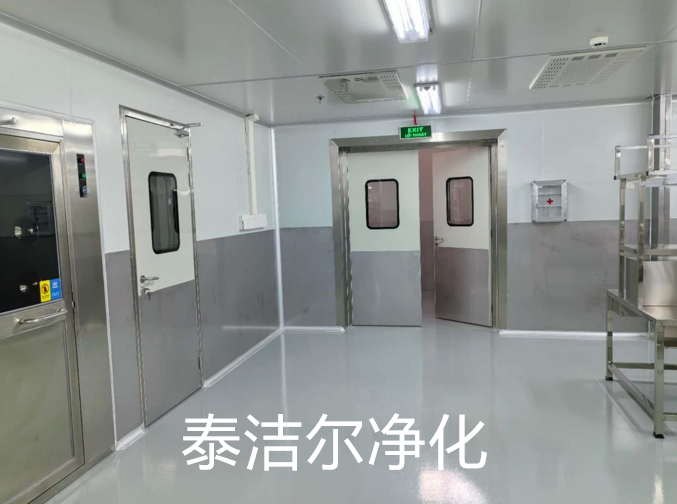
Once a purification engineering system is commissioned, a risk-based monitoring plan maintains compliance. Typical intervals:
Daily : Visual checks of differential pressure gauges, temperature/humidity records, door interlock function.
Weekly : Surface particle sampling (swab + particle counter) at critical workstations.
Monthly : HEPA filter integrity scan for accessible filters; check pre-filter pressure drop.
Quarterly : Full particle count for each classified zone (minimum 5 sampling locations per 100 m²).
Annually : Air change rate measurement, recovery test, and smoke pattern visualization (for unidirectional zones).
Data trending identifies gradual filter loading or developing leaks. When particle counts exceed 50% of action limits (e.g., ISO Class 5 limit = 3,520 particles ≥0.5 µm/m³, action limit set at 1,760), an investigation is triggered. Portable particle counters and thermal anemometers enable in-house teams to perform intermediate checks without waiting for external certification.
Many manufacturing sites face the challenge of upgrading existing buildings to meet stricter contamination standards. Purification engineering offers modular solutions that work within low ceiling heights (2.4–2.7 m) and existing HVAC constraints. The retrofit sequence includes:
Baseline audit : 72-hour particle mapping to identify leakage paths (unsealed conduits, porous ceiling tiles).
Envelope sealing : Apply polyurethane sealant to all cracks; install cleanroom-rated light fixtures.
Modular wall systems : 50mm aluminum-framed panels with smooth PVC surface – installed without welding or debris.
Decentralized FFU installation : Mount fan-filter units on existing structural ceiling; provide independent power and control.
Airlock integration : Retrofit interlocked doors with pass-through chambers and HEPA-filtered air showers.
Retrofit purification engineering typically achieves ISO Class 6 at 40–60% lower capital cost than new construction. Energy savings come from EC-motor FFUs and demand-controlled air changes based on real-time particle counts.
Q1: What is the difference between purification engineering and
standard HVAC design?
A1: Standard HVAC focuses on thermal comfort
and basic filtration (MERV 8–13). Purification engineering specifies HEPA/ULPA
filtration, unidirectional airflow modeling, pressure cascades, and real-time
particle monitoring. It also addresses molecular contamination (AMC) and viable
particle control. The design criteria are driven by ISO 14644 and
industry-specific GMP standards, not by human comfort.
Q2: How do you determine the required air change rate for a
purification engineering project?
A2: Air change rate (ACH) is
derived from the desired recovery time. Formula: ACH = (ln(C0/Ct) × 60) / t,
where C0 = initial particle concentration (e.g., 1,000,000 particles/m³), Ct =
target concentration (e.g., 3,520 particles/m³ for ISO Class 5), t = allowed
recovery time (e.g., 15 minutes). For ISO Class 5, ACH typically ranges from 250
to 600. CFD simulation helps refine the value based on room geometry and heat
load.
Q3: Can purification engineering be applied to existing cleanrooms
without production stoppage?
A3: Yes, through phased modular
retrofitting. Work in sections isolated with temporary soft-wall barriers and
portable HEPA filter units. Overnight or weekend shifts execute panel
installation, FFU replacement, and sealant curing. TAI JIE
ER has completed such projects with zero production loss by using
pre-tested modular components and detailed logistics planning.
Q4: What are the most frequent failures during purification
engineering certification?
A4: Based on field data, the top three
failures are: (1) Filter seal leaks – gasket compression insufficient; (2)
Incorrect air velocity uniformity – blocked diffusers or unbalanced FFU speed;
(3) Pressure cascade reversal – doors not self-closing or HVAC dampers
misadjusted. Pre-certification mock tests using a handheld photometer and
thermal anemometer identify these issues before the official audit.
Q5: How does purification engineering address airborne molecular
contamination (AMC) in semiconductor fabs?
A5: AMC control requires
chemical filters (activated carbon with permanganate or acid gas removers)
installed in the make-up air unit and recirculation loops. Monitoring uses ion
mobility spectrometry (IMS) or cavity ring-down spectroscopy (CRDS) for
real-time ppb/ppt levels. Surface sampling with wafer coupons and GC-MS analysis
is done monthly. Purification engineering designs separate exhaust paths for
process tools emitting reactive gases (e.g., TEOS, HF).
As product geometries shrink (sub-3nm logic) and biologics become more potent, purification engineering must evolve. Emerging trends include mini-environment isolation at the tool level, predictive filter maintenance using IoT particle counters and AI algorithms, and energy-optimized cleanroom protocols that reduce ACH during idle periods. Working with an experienced engineering partner ensures that your contamination control strategy adapts to new regulations (EU GMP Annex 1 2023 revision) and process nodes.
For organizations planning a new purification engineering project or retrofitting an existing facility, a structured technical consultation provides ROI analysis, risk assessment, and customized CAD designs. TAI JIE ER offers end-to-end services: from ISO class definition and filter selection to commissioning and annual re-certification.